Run locally
Qwen3.6-27B
Radeon AI PRO R9700 · 2 runs
- Hardware
- Radeon AI PRO R9700gfx1201 · RDNA4
- Memory
- 32 GB dedicated
- Tasks
- Moorhuhn, Clair Obscure, Image recognition
- Quantisations
- UD-Q6_K_XL

Personal opinion
Kai Bennett
The model worked surprisingly well for me in combination with the Hermes Agent and the Telegram Gateway. Through the Telegram Gateway built into Hermes, you get a very usable remote control for your PC, free of charge, in this setup even controllable by voice, including image recognition. The setup is a good chat alternative to the big providers, completely free and without sharing all your data. Tool use, for example fetching current data via web search, also works surprisingly well. In coding, it completes smaller tasks autonomously, mostly in usable quality.
From my assessment of its successor, Qwen3.8-27B. A separate assessment of the 3.6 is still pending.
About the model
Dense model with 27 billion parameters, 64 layers, hidden dimension 5120 and 262,144 tokens of native context, extensible to 1,010,000 tokens according to the model card. The layers follow the pattern 16 × (3 × (Gated DeltaNet → FFN) → 1 × (Gated Attention → FFN)); config.json states full_attention_interval 4 for this. Gated Attention uses 24 query heads and 4 key/value heads at head dimension 256, Gated DeltaNet uses 48 value heads and 16 QK heads at head dimension 128, and the FFN intermediate dimension is 17408. The model card gives the type as "Causal Language Model with Vision Encoder" and lists Multi-Token Prediction as part of training.
- Architecture type
- Dense (supported only by the article title on the card)
- Parameters
- 27B
- Layers
- 64
- Layer pattern
- 16 × (3 × (Gated DeltaNet → FFN) → 1 × (Gated Attention → FFN))
- Context length
- 262,144 tokens native, extensible up to 1,010,000 tokens
- Multi-Token Prediction
- trained with multiple steps (MTP)
- License
- Apache-2.0
Figures from the vendor: Source · Model card · Vendor
Run: Moorhuhn · UD-Q6_K_XL · reasoning on, budget of 20,000 tokens · 02 September 2026
The numbers at a glance
Decode, median
33.45 t/s
221 scored responses
Decode, p10 to p90
29.02–38.25 t/s
Responses from 200 tokens up are scored; shorter ones produce outliers of over 1,000,000 t/s in the log, because a single token there takes almost zero milliseconds. Classic median, percentiles by rank. This threshold does NOT apply to prefill, where every evaluation counts.
Peak
41.39 t/s
a single response
Prefill, median
152.7 t/s
Output generated
175,743 Token
scored responses only, from 200 tokens up
Runtime
2.5 h
153 minutes
Self-corrections
12
Responses in total
409
221 of them scored
Input in total
28.66 Mio. Token
the context of all 409 requests added up
of that newly computed
546,453 Token
28.11 million were in the prompt cache
Through the model in total
28.86 Mio. Token
input and output together
At a hosting provider
1.40 USD
Qwen3.6-27B hosted, cheapest rate
What this run would have cost with Qwen3.6-27B at a hosting provider
| Provider | Inputper M | Outputper M | Cacheper M | This runwithout cache | This runwith cache |
|---|---|---|---|---|---|
| Chutes | 0.30 | 2.00 | 0.030 | 8.99 | 1.40 |
| SiliconFlow | 0.30 | 3.20 | · | 9.23 | · |
| Phala | 0.32 | 2.70 | 0.150 | 9.70 | 4.92 |
| Alibaba Cloud Int. | 0.45 | 2.70 | · | 13.43 | · |
All amounts in USD. The first three columns are tariffs per million tokens, the last two are the total for this run. Calculated with the same tokens as on the left: 28,659,296 input across all requests, of which 546,453 were newly computed and 28,112,843 came from the prompt cache, plus 196,543 output. The “without cache” column charges the entire input at the input rate, the “with cache” column charges the cached part at the provider's cache rate. Providers with a cache rate are the norm, so the right column is the more realistic one. These are the prices for Qwen3.6-27B itself, at providers that host exactly this model, not those of some other cloud model. As of 8 September 2026, list prices without volume discounts. Locally, the run costs electricity and the purchase of the card instead. Prices at OpenRouter, retrieved 2026-09-08.
What this run would have cost with Sonnet 5 at the same token consumption
| Model | Inputper M | Outputper M | Cache writeper M | Cache readper M | This runwithout cache | This runwith cache |
|---|---|---|---|---|---|---|
| Sonnet 5 | 2.00 | 10.00 | 2.50 | 0.20 | 59.28 | 8.95 |
All amounts in USD. The first four columns are tariffs per million tokens, the last two are the total for this run. Calculated with exactly the tokens of this run: 28,659,296 input, of which 546,453 new and 28,112,843 from the cache, plus 196,543 output. Without cache at the input rate; with cache, the new part pays the write rate and the cached part the read rate. This is a comparison that assumes the same token consumption. A different model solves the same task with a different number of tokens, usually fewer; so the row says what these tokens would have cost with Sonnet 5, not what Sonnet 5 would have cost for this task. Anthropic price list, retrieved 2026-09-08.
llama.cpp server log · 221 of 409 responses from 200 tokens up. The server ran for 3 h 56 min in one go; this includes four pauses totalling 82.0 minutes in which nothing was computed. The working window without these pauses is 153.2 minutes, about 2 h 33 min. Of that, pure compute time on the GPU is 139.1 minutes. · Raw log
Results
Moorland Mayhem — Featherstorm
Opens in its own layerAim and shoot with mouse or finger. Needs WebGL.
Loads only on click · 0.3 MB transfer · 1.5 MB unpacked
Prefill over context depth
A peak figure at short context says little about how a model feels after hours. Hence the curve.
Context depth in thousands of tokens · Instantaneous rate within a single continuous prefill: task 39083 of this run processed 43,238 tokens in one go. llama.cpp reports an intermediate status every 2,048 tokens; the rate is the quotient of tokens and time between two consecutive reports. Of 23 intermediate pieces, 19 remain; four leftover pieces under 1,500 tokens are discarded, because there the call overhead is measured rather than depth. The decline is monotonic across all 19 steps, without outliers. Every third one is plotted, seven points, including start and end. From 3K to 41K the rate drops by a factor of 1.44. Every point can be recalculated from the linked server log.
llama.cpp launch parameters
- Context
- 172,032
- KV-Cache
- q8_0 / q4_0
- Micro-Batch
- 512
- Speculative
- draft-mtp · n_max 2
- Build
- b9985
llama-server -m Qwen3.6-27B-UD-Q6_K_XL-mtp.gguf ^
  --mmproj mmproj-F16.gguf --alias Qwen3.6-27B ^
  --host 127.0.0.1 --port 8080 ^
  -c 172032 -ngl 99 -fa on ^
  -ctk q8_0 -ctv q4_0 -b 2048 -ub 512 ^
  --parallel 1 --kv-unified ^
  --ctx-checkpoints 4 --checkpoint-min-step 16384 --cache-ram 16384 ^
  --spec-type draft-mtp --spec-draft-n-max 2 ^
  --temp 0.6 --top-p 0.95 --top-k 20 --min-p 0.0 ^
  --jinja --chat-template-file qwen-fixed-chat_template.jinja ^
  --reasoning on --reasoning-format deepseek --reasoning-budget 20000
Assessment
20 / 40
The grade is a personal, and therefore subjective, assessment.
Game feelDoes it run, and does it play?
6/10
The hit area was only right after twelve attempts. Poorly playable and not fun.
PresentationMenus, HUD, graphics, sound
6/10
Recording available, menus simpler than in the successor.
Code qualityTests, structure, self-corrections
2/10
Not a single real test, the only test file is the vitest configuration with 15 lines. Instead, twelve repair scripts with 557 lines in total, four times fix_coords, three times fix_hit, all on the same coordinate and hit problem.
ScopeHow much of the prompt was fulfilled?
6/10
39 files, 6,888 lines. The tests and some details are missing.
This assessment is a proposal and has not yet been confirmed by Kai Bennett. Code quality and scope rest on counted files, source and test lines and repair scripts in the evidence repository.
How do you see it? The grade above is a personal assessment. Here yours counts, independently of it.
What went wrong
There were 12 self-corrections by the model.
llama.cpp server log · 221 of 409 responses from 200 tokens up. The server ran for 3 h 56 min in one go; this includes four pauses totalling 82.0 minutes in which nothing was computed. The working window without these pauses is 153.2 minutes, about 2 h 33 min. Of that, pure compute time on the GPU is 139.1 minutes.
Run: Clair Obscure · UD-Q6_K_XL · reasoning on, budget of 20,000 tokens · 23 July 2026
The numbers at a glance
No server log was recorded, so neither speed nor token count. Only the model and the setup are documented, via the launch script, and the artefact itself.
What can be verified is the absence itself: for this run, the evidence repo lists “Rohprotokoll: keins” (raw log: none) under LAUF.md, and the checksum list evidence/SHA256SUMS contains six logs, none of them for Qwen3.6 with Clair Obscure. The work took place between 23 and 27 July 2026.
Results
No playable build is on record for this run.
llama.cpp launch parameters
- Context
- 172,032
- KV-Cache
- q8_0 / q4_0
- Micro-Batch
- 512
- Speculative
- draft-mtp · n_max 2
- Build
- b9985
llama-server -m Qwen3.6-27B-UD-Q6_K_XL-mtp.gguf ^
  --mmproj mmproj-F16.gguf --alias Qwen3.6-27B ^
  --host 127.0.0.1 --port 8080 ^
  -c 172032 -ngl 99 -fa on ^
  -ctk q8_0 -ctv q4_0 -b 2048 -ub 512 ^
  --parallel 1 --kv-unified ^
  --ctx-checkpoints 4 --checkpoint-min-step 16384 --cache-ram 16384 ^
  --spec-type draft-mtp --spec-draft-n-max 2 ^
  --temp 0.6 --top-p 0.95 --top-k 20 --min-p 0.0 ^
  --jinja --chat-template-file qwen-fixed-chat_template.jinja ^
  --reasoning on --reasoning-format deepseek --reasoning-budget 20000
Assessment
22 / 40
The grade is a personal, and therefore subjective, assessment.
Game feelDoes it run, and does it play?
6/10
The artefact exists and starts, a turn based battle. Without a log, nothing about the course of the run is documented.
PresentationMenus, HUD, graphics, sound
6/10
Recording available, combat HUD visible.
Code qualityTests, structure, self-corrections
4/10
No test files, but also not a single repair script, unlike the Moorhuhn run of the same model.
ScopeHow much of the prompt was fulfilled?
6/10
26 files, 8,705 lines, including 24 JavaScript files in the source code. The 96 graphics and sound files are CC0 material and not counted.
This assessment is a proposal and has not yet been confirmed by Kai Bennett. Code quality and scope rest on counted files, source and test lines and repair scripts in the evidence repository.
How do you see it? The grade above is a personal assessment. Here yours counts, independently of it.
What went wrong
No self-corrections were logged.
What can be verified is the absence itself: for this run, the evidence repo lists “Rohprotokoll: keins” (raw log: none) under LAUF.md, and the checksum list evidence/SHA256SUMS contains six logs, none of them for Qwen3.6 with Clair Obscure. The work took place between 23 and 27 July 2026.
Image recognition
A separate test run with the same model on the same machine, part of a different run.
Values read
50 of 50
dashboard, 50 checkable entries
Price tags
4 of 4
read fully correctly
Invented tags
0
none claimed as certain
Traps passed
4 of 4
places that break the pattern
Provisional: the answer key for the price tags is not fully confirmed yet.
Task 1 · reading values
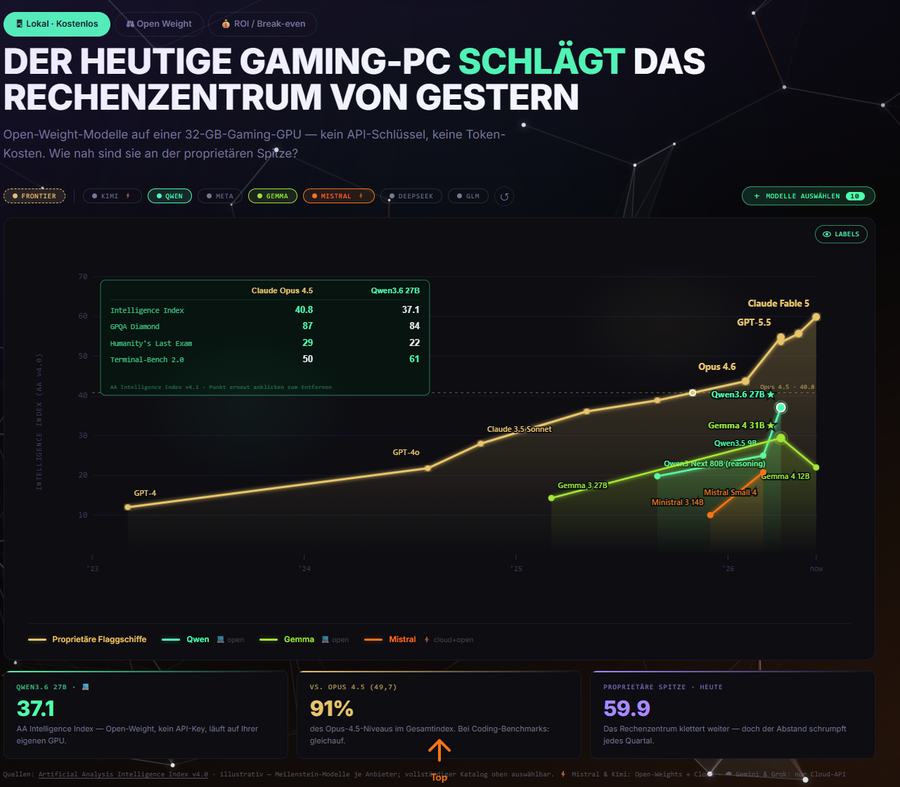
What the model read from the tooltip table
| Claude Opus 4.5 | Qwen3.6 27B | |
|---|---|---|
| Intelligence Index | 40.8 | 37.1 |
| GPQA Diamond | 87 | 84 |
| Humanity's Last Exam | 29 | 22 |
| Terminal-Bench 2.0 | 50 | 61 |
And from the KPI tiles
- QWEN3.6 27B 37.1 · AA Intelligence Index — Open-Weight, kein API-Key, läuft auf Ihrer eigenen GPU.
- VS. OPUS 4.5 (40,7) 91% · des Opus-4.5-Niveaus im Gesamtindex. Bei Coding-Benchmarks: gleichauf.
- PROPRIETÄRE SPITZE · HEUTE 59.9 · Das Rechenzentrum klettert weiter — doch der Abstand schrumpft jedes Quartal.
Task 2 · complex text recognition
What is tested is the reading of tiny, tilted, partly hidden text in a photo with more than forty objects, plus two currency symbols that are hard to tell apart once rotated. The price tags are what the test is run on.
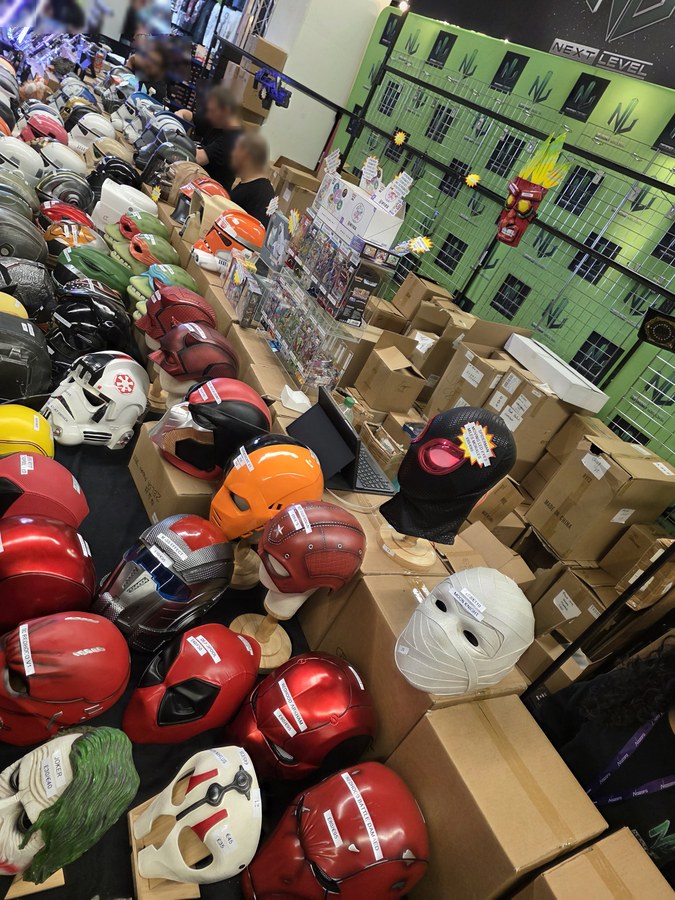
What the model read
| What the model read there | £ | € | Order | certain | |
|---|---|---|---|---|---|
| 1 | JOKER | 30 | 40 | gbp zuerst | yes |
| 2 | REDHOOD ARKHAM | 80 | 65 | gbp zuerst | yes |
| 3 | REDHOOD BATTLE DAMAGED | 80 | 65 | gbp zuerst | yes |
| 4 | unnamed | 35 | 45 | eur zuerst | yes |
| 5 | DC REDHOOD V1 | not readable | not readable | · | no |
| 6 | DEADPOOL | not readable | not readable | · | no |
The model counted 6 tags in the scored area. The answer key is deliberately not shown beside it, otherwise a later model could read it off this page.
The model on the hardest part: „Die Preisschilder auf Bild B bei starkem Drehwinkel — insbesondere DEADPOOL und DC REDHOOD V1, wo die Währungszeichen £ und € bei der Schräglage nicht sicher unterscheidbar sind. Auch die exakte Position des REDHOOD BATTLE DAMAGED-Schilds relativ zur x=700-Grenze ist unsicher.“
Where the model called itself unsure (4 places)
- DEADPOOL: Preistag im Winkel, Zahlen und Währungszeichen nicht sicher lesbar
- DC REDHOOD V1: Preistag nicht einsehbar (Nur Name lesbar)
- REDHOOD BATTLE DAMAGED: ob Schild innerhalb x<700 liegt (am Rand des Wertungsbereichs)
- Weiße Maske: ob ein Name auf dem Schild steht (nicht erkennbar, nur €45/£35 lesbar)
The model wrote this list itself, not the scorer. It counts: an admitted “not readable” costs one point, an invented entry costs more.
The complete answer of the model as JSON · The scoring is not published beside it: it names the correct value for every mistake, which would put the answer key in the open.
Sources
- Model weightshuggingface.co/unsloth/Qwen3.6-27B-GGUF
- Model cardhuggingface.co/Qwen/Qwen3.6-27B
- Vendor siteqwen.ai
- Measurement repositorygithub.com/KaiFelixBennett/local-ai-amd-benchmark
- Raw log of this rungithub.com/KaiFelixBennett/local-ai-amd-benchmark/blob/main/evidence/logs/qwen36-27b-q6-moorhuhn-r9700.log
- Source code · Moorhuhn · UD-Q6_K_XL · Reasoning on, budget of 20,000 tokensgithub.com/KaiFelixBennett/local-ai-amd-benchmark/tree/main/benchmarks/qwen36-27b/moorhuhn-q6
- Source code · Clair Obscure · UD-Q6_K_XL · Reasoning on, budget of 20,000 tokensgithub.com/KaiFelixBennett/local-ai-amd-benchmark/tree/main/benchmarks/qwen36-27b/clairobscure-q6
Try it yourself
- Download the weights · Source
- Start llama-server with the parameters above
- Register the endpoint in VS Code as a custom model and pick the agent
Prompt, agent files and tools: Agent Test Harness
Citation: Kai Felix Bennett, “Usability test of local AI on AMD hardware”, benchmark.securesight.ai, run qwen36-27b-q6-moorhuhn-r9700. Measurement data CC-BY-4.0.
Measurement data CC-BY-4.0, code MIT.