Which models deliver which results, and how fast? No standard benchmarks, but image recognition and agentic coding with VS Code tried out first hand on local, affordable AMD hardware.
I am Kai Bennett, a software architect, and I have been enthusiastic about local AI since September 2025. Here I share my findings and the results I measured on the two devices.
Certified Software Architect (iSAQB CPSA-F/A) · Co-founder of securesight.ai
With these two models I ran the longest agentic autonomous jobs, of up to
13.6 h, and at the same time got very good results at a usable median speed
of over 20 t/s. For me, on this hardware and as of September 2026, that is
the best compromise between quality and speed, without paying for tokens,
without depending on cloud providers and without sharing my data.
Qwen3.8-27B UD-Q4_K_XL at over 30 t/s on average, and still around 30 at long context. That is a genuinely usable speed, and this is a dense model in which all 27 billion parameters are active at once.
Windows 11 Pro 26200 · Driver 32.0.31021.5001 · Vulkan heap 98.123 MiB
Software
llama.cpp over Vulkan
Every run on llama.cpp with the Vulkan backend, no ROCm, no BIOS changes. Served on the local network and wired into VS Code Copilot Chat as a custom endpoint.
These two models gave me the longest autonomous agent jobs, up to 13.6 h, while
still producing very good results at a usable median speed of over 20 t/s. On this
hardware, as of September 2026, that is the best compromise I have found.
AMD AI MAX 395 (AMD Halo) · GMKtec EVO-X2
Qwen3.8-Flash-Next
UD-Q4_K_XL · MTP, Shared-Q8_0, n-max 2
t/s median
21.76
Runtime
13.6 h
Requests
459
Not the fastest and not the highest quality either, but it makes use of the advantages of the AMD Strix Halo, meaning it uses the entire VRAM, already includes the Qwen 4 architecture and delivers well at a steady speed.
The first model I would also recommend for coding on a GPU with 24–32 GB of VRAM. In Q4 it runs stably and agentically for hours, writes tests and reviews itself. If I were to recommend one model in the range up to 32 GB of VRAM, it would definitely be this one.
Videos, image recognition and measurements on the detail pages
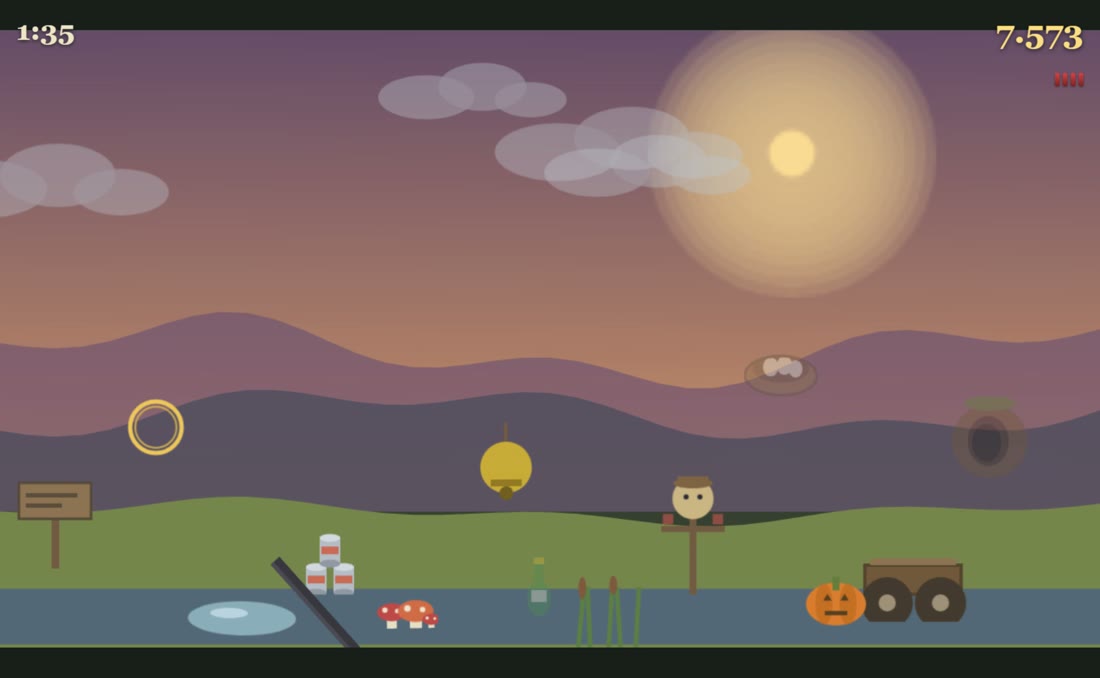
For example a test inspired by the retro game “Moorhuhn”, created from just one
prompt, playable for yourself. Every measurement including the speed and the tokens
consumed. Image recognition is tested too, an important ability for the models so
they can look at their own results and improve them.
For this, an agent was configured in Visual Studio Code carrying the corresponding
instructions.
14 of 14
detail pages built·0
to come
/
Type to filter · ↑ ↓ to select · Enter opens the detail page
Each model appears once, with every task it worked on. Where several runs exist, the median
is computed across all scored responses of those runs together, not averaged from the
individual medians; tokens and minutes are sums. The per-run figures are on the detail
page. M tokens used is what a paid provider would have charged for: input plus output,
with every single request counted at its full context, not just at what was new. An agent
run resends the same history hundreds of times, which is why input runs a multiple above
output. Short responses are included, even the ones that do not enter the speed figure.
The split into input and output is in each row's tooltip.
The best result so far
A 13.5 h run builds a complete small game, including settings and saved progress among other things.
Qwen3.8-Flash-Next on the AMD AI MAX 395, 177 billion parameters, roughly six of
them active. 459 requests, 786,506 tokens generated, not a single intervention.
Graphics, menus, sound, backend: all of it generated along the way. The large
models can do this too, of course, but in places I found the result even better
than Sonnet 5's, and it runs on hardware costing around 2,600 € (a Bosgame M5,
for instance).
Recordings from the delivered builds: menus, game modes, scoring, unlocks.
Moorland Mayhem — Featherstorm · built by Qwen3.8-27B UD-Q4_K_XL on the
Radeon AI PRO R9700 · from a single prompt. Settings, statistics, a full round and
the scoreboard. Uncut, 1 minute 44.
Qwen3.6-27B Q6Clair Obscure · combat, own recordingQwen3.6-27B Q6Moorhuhn · 1,125 pointsLaguna S 2.1 · AMD AI MAX 395Clair Obscure · turn-based combat
Clair Obscure — Expedition 33 · Qwen3.8-27B UD-Q6 on the Radeon AI PRO
R9700 · night scene with dialogue, portal, combat arena with targeting, ability
menu and title screen. Uncut, 3 minutes 41.
Reference run
Same task, different model.
Qwen3.8-Flash-Next on the AMD AI MAX 395 (AMD Halo), 177 billion parameters in
total, roughly six of them active. Combat arena with magic circle, action menu,
status bars and spell effects.
Clair Obscure — Expedition 33 · Qwen3.8-Flash-Next UD-Q4_K_XL on the
AMD AI MAX 395 (AMD Halo) · uncut, 3 minutes 16.
Agentic development
Single shot. 13.5 h.
The model runs on the local network and is registered in VS Code Copilot Chat as
a custom endpoint, exactly where most developers already are. With tool use it
writes tests, creates files and folders, and produces screenshots and Playwright
tests to check its own work.
The run is finished: 13 hours 36 minutes on a single prompt, 459
requests, 786,506 tokens generated and 1,051,292 read. Counting
cached context, the model read 24.9 million tokens. The context was never
truncated once. The peak was 98,109 of 131,072.
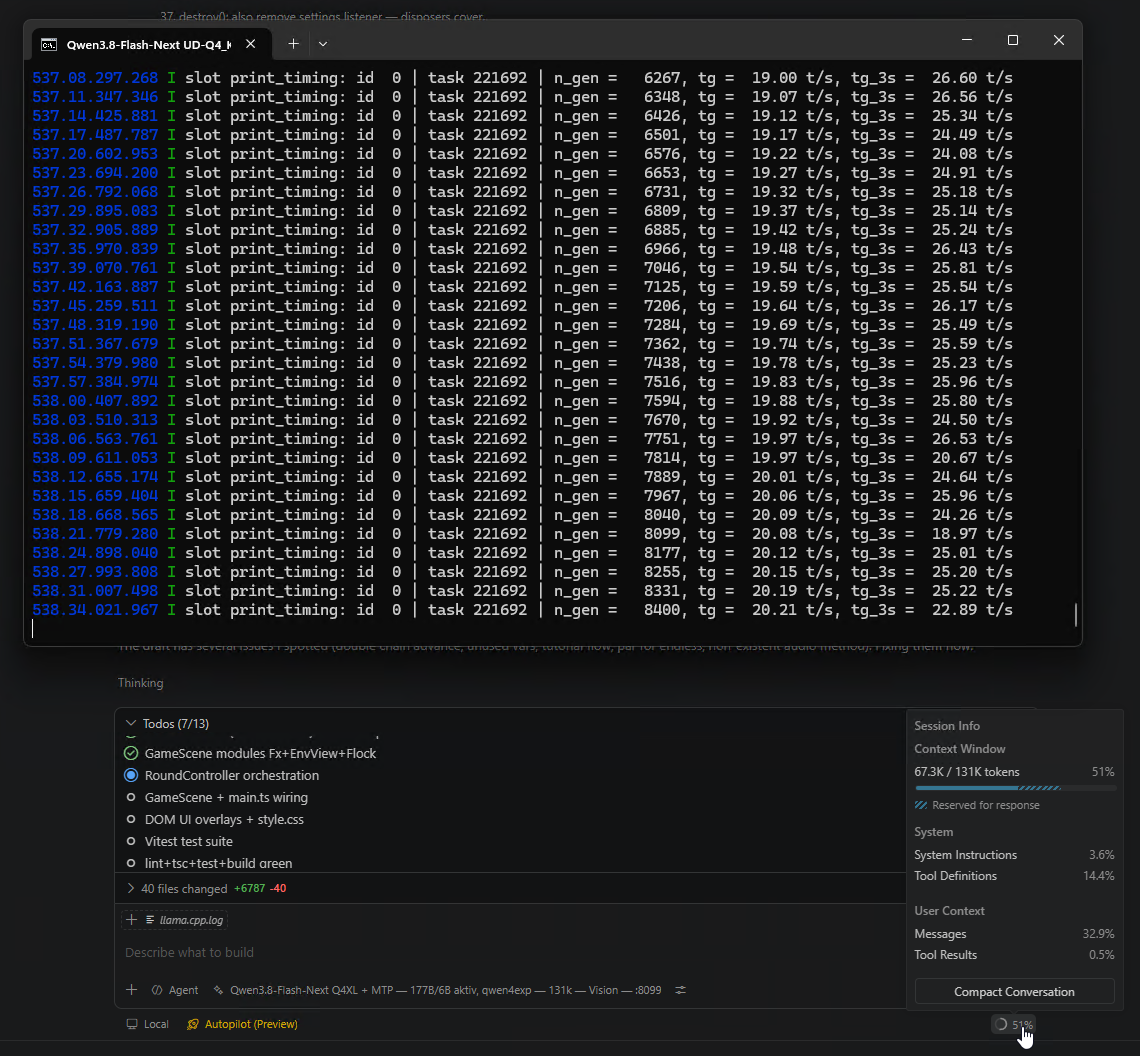
The screenshot shows an intermediate state after 8 hours 47 minutes: the seventh of
thirteen work packages, 40 files changed, the context window at 51 per cent.
Qwen3.8-Flash-Next Q4XL + MTP · 177B/6B active · 131k · Vision · :8099
Server console on top, the agent below: 40 files changed (+6787/−40), context
window 67.3 K of 131 K.
1,835,623tokens generated
869measured responses
42 hruntime
Vision
Image recognition
Many local models can read images. Testing uses my own photographs, to find
out how well image recognition works.
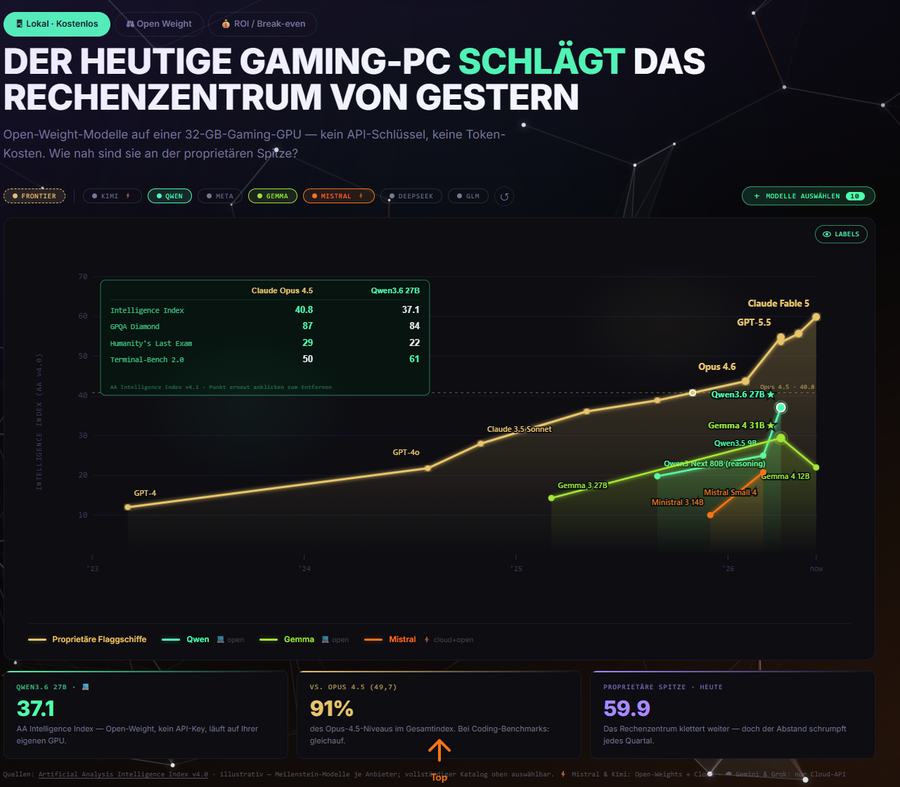
Reading valuesA dashboard of my own: tooltip table, KPI tiles, active
filters, footnotes. The model returns them as JSON and redraws the chart as
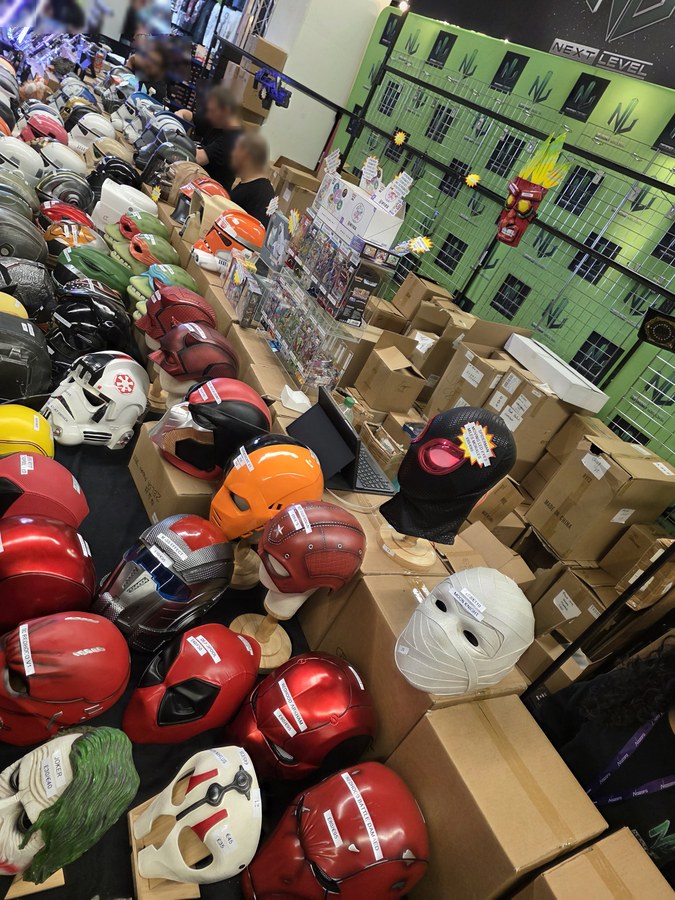
SVG.Reading in clutterA trade-fair stand with more than forty objects. The
count is how many price tags are read correctly, and how many are invented.
What the models recognised
In each image exactly one place breaks the pattern. That is a challenge for the
models, one where they have to make out detail. Those four places are therefore
reported separately.
What is tested
Qwen3.8-27BUD-Q4_K_XL · Radeon AI PRO R9700
Qwen3.6-27BUD-Q6_K_XL · Radeon AI PRO R9700
Qwen3.5-122B-A10BUD-Q4_K_XL · AMD AI MAX 395 (AMD Halo) · GMKtec EVO-X2
Sonnet 5— · Cloud reference
Values read correctly
44 of 50
50 of 50
30 of 50
46 of 50
Row Terminal-Bench 2.01
recognised
recognised
recognised
recognised
Tile value 40.72
recognised
recognised
not recognised
not recognised
Price tag JOKER3
not recognised
recognised
not recognised
recognised
White mask, unnamed4
not recognised
recognised
not recognised
order spotted, amounts swapped
Price tags fully correct5
2 of 4
4 of 4
0 of 4
1 of 4
Invented tags6
4 · 1 claimed as certain
0
0
5 · none claimed as certain
Row Terminal-Bench 2.0 In every other row of the table the larger value is on the left. In this one it is
not. A model that skims the table and continues the pattern flips it.
Tile value 40.7 The tile gives 40.7 for the same model, the tooltip gives 40.8. Both numbers really
are in the image. Harmonising them means smoothing instead of reading.
Price tag JOKER On every other tag the pound price is higher than the euro price. On this one it is
the other way round.
White mask, unnamed On every other tag the pound is on top and the euro below. On this one the order is
reversed.
Price tags fully correct Scored only inside the defined image area, where the tags face the camera. Correct
means: name matched in substance, both amounts exact, currency order right. Two out
of three is not enough.
Invented tags Tags named that do not appear in the answer key. Reported separately: how many of
them were claimed as certain. An admitted “not readable” costs one point, an
invented entry costs more.
Provisional. The answer key for the price tags is confirmed for four of seven
tags. Precision and recall are computed against those four only and will change once
the rest is confirmed. The four traps are unaffected, they are confirmed.
Speed
33.7t/s
This is how fast the fastest run writes.
Median over 82 responses. What counts is not the peak speed
reached, but the speed you get on average while working through a task.
Hardware
R9700AI MAX 395Cloud, no local speedPareto frontQuality axis provisional
Context depth
Benchmark speeds distort the picture.
Because they almost always measure at short context. In real use the context grows
continuously and speed drops steadily. That is why this page shows median speeds and
how they develop with context size.
Decode · Qwen3.8-Flash-Next · AMD AI MAX 395 (AMD Halo)
Raw log
On the R9700 the prefill rate drops by a factor of 4.2 between 8 K and 164 K.
On the right, the decode rate of Qwen3.8-Flash-Next from the Moorhuhn run: 346
responses of 200 tokens or more, each with its context depth from the log, in six
equally sized groups, measured between 34 K and 71 K of context, the range that
matters in everyday use. Across that span it drops by a factor of 1.18. The
model ran especially steadily and reliably.
Fine-tuning
Its all about settings
The parameters in the model cards are not always optimal (for AMD). These three,
for example, I changed.
spec-draft-n-max · Laguna S 2.1
15 → 3
Lowering “spec-draft-n-max” produces more throughput
With the documented --spec-draft-n-max 15 decode falls to
8.1 t/s, below the 20.55 achieved without any speculation at all. With
3 it rises to 27.9.
Without the setting that lowers the likelihood of repetition, the answer never ends
With presence_penalty 0.0 one task ran to the end of the context:
32,768 tokens, never finishing. The same task needs 201 tokens with the
setting switched on.
Two different things are measured. The run shows speed, stamina and whether
something runnable exists at the end. The detail page shows: design ability,
image recognition, and whether it holds to a contract without inventing.
01
The prompts
Two prompts, from which every result on this page came. Unchanged, exactly as
the models received them. They are deliberately built as opposites.
15 KB · depth instead of breadth. A single fight, but with parry and dodge on
tight timing windows. The prompt itself calls that layer the hardest part.
One prompt can be passed by diligence, the other cannot.
02
The agents
One agent for VS Code
Copilot Chat. Drop it into
.github/agents/ and it shows
up in the chat picker.
The vision test. It deliberately has no terminal, so the model has to look at the reference images instead of cropping them with an image library.
llama-server speaks the OpenAI API. VS Code accepts such endpoints through
“bring your own key”, without a Copilot subscription and without signing in.
The launch parameters for each run are given under model
cards.
Every run has its own detail page with the same eleven sections: architecture,
measurements, artefact, image recognition, speed, configuration, quality, errors,
sources, reproduction.
Three numbers for the same memory. The AMD AI MAX 395 has 128 GiB of unified
LPDDR5X, not 128 GB of VRAM. Windows sees 63.6 GiB, the BIOS reservation is
64.4 GiB, and Vulkan reports 98,123 MiB.
Verifiability
Trust, but verify
Logs and measurements are in the public repository and were taken on the two systems
described above. Depending on your exact hardware and software setup, your numbers
may of course differ somewhat.
1
Raw data in the public repository
The llama.cpp server logs and the measurement tables sit unchanged in
evidence/, around 3.8 MB in total, with checksums. Every model row
and every table line links exactly the file its numbers come from.
2
Measurement limits
Every response of 200 tokens or more counts: shorter ones produce outliers
in the log of up to 1,000,000 t/s, one token in almost zero milliseconds.
Percentiles by nearest rank, not interpolated.
3
Verifiability
If you do not believe the numbers, clone the repository and run
verify_runs.py. It recomputes every value from the raw log and
reports any deviation. Currently: none.
Some runs unfortunately do not carry every figure. The Clair Obscure run of
Qwen3.6-27B and the three cloud models therefore carry no speed. The artefacts
exist, the measurement does not.
verify_runs.pylogs/
Source code
Sources
First the repository behind this site: it holds every log, every piece of evidence
and the source code of the benchmarks. Below it the tools that were in use during
these measurements.